Indevolt
The Indevolt integrationIntegrations connect and integrate Home Assistant with your devices, services, and more. [Learn more] enables direct local communication between Home Assistant and your Indevolt energy storage devices.
Use cases
With this integration, you can monitor energy production, consumption, and battery status in real time. You can also manage battery working modes, control real-time charging and discharging behavior, and configure power limits and other battery protection settings.
Beyond basic monitoring, the Indevolt integration enables advanced energy management automations within Home Assistant. For example, you can:
- Optimize battery charging and discharging based on solar production forecasts
- Automatically adjust energy modes to take advantage of variable electricity pricing
- Prevent grid feed-in during peak tariff periods by dynamically limiting output power
- Maintain a minimum battery charge for backup scenarios by adjusting discharge limits when applicable
- Coordinate battery behavior with other Home Assistant energy devices for whole-home optimization
Supported devices
The integration supports the following devices:
- BK1600 / BK1600 Ultra
- SolidFlex 1200
- SolidFlex 2000 / PowerFlex 2000
- SolidFlex 3000 / PowerFlex 3000
- SolidFlex 3600 / PowerFlex 3600
Prerequisites
- Connect your Indevolt device and Home Assistant to the same local network.
- Ensure the Indevolt device is powered on and has acquired a network IP address.
- In the Indevolt app, enable the Local API and set the protocol to
http.
Configuration
To add the Indevolt device to your Home Assistant instance, use this My button:

Indevolt can be auto-discovered by Home Assistant. If an instance was found, it will be shown as Discovered. You can then set it up right away.
If it wasn’t discovered automatically, don’t worry! You can set up a manual integration entry:
-
Browse to your Home Assistant instance.
-
In the bottom right corner, select the
Add Integration button. -
From the list, select Indevolt.
-
Follow the instructions on screen to complete the setup.
By default, the Indevolt sensors will be updated every 30 seconds. You can disable polling using system options and use the update entity action to define your own update frequency.
If you want to define a specific interval at which your device is being polled for data, you can disable the default polling interval and create your own polling automation.
To add the automation:
- Go to Settings > Devices & services, and select your integration.
- On the integration entry, select the
. - Then, select System options and toggle the button to disable polling.
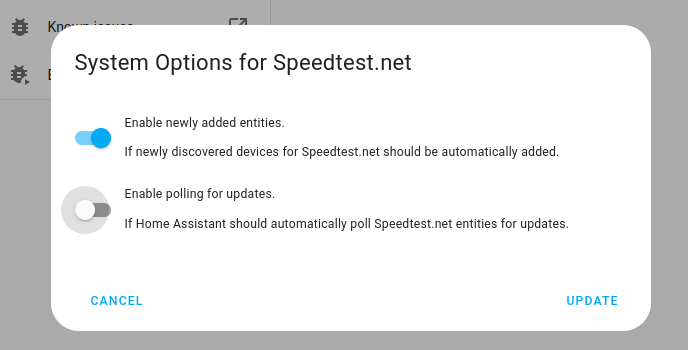
- Then, select System options and toggle the button to disable polling.
- To define your custom polling interval, create an automation.
- Go to Settings > Automations & scenes and create a new automation.
- Define any trigger and condition you like.
- Select Add action, then select Other actions.
- Select Perform action, and from the list, select the
homeassistant.update_entityaction. - Add the entities you want to poll to the Entity field. The
homeassistant.update_entityaction only supports targeting by entity. Selecting an area, device, or label is not supported.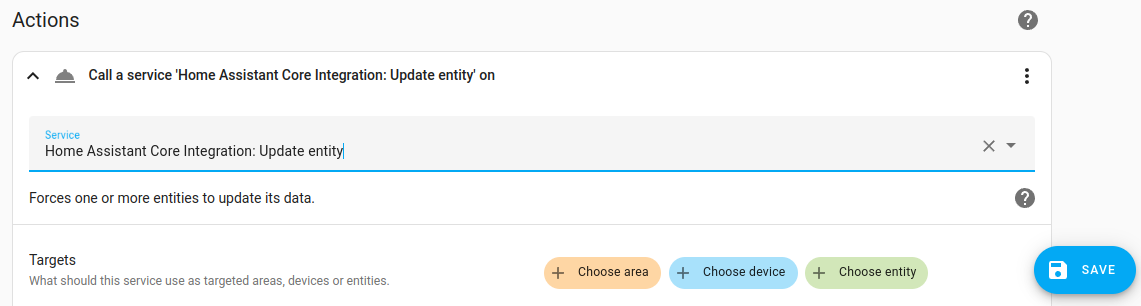
- Save your new automation to poll for data.
Note that homeassistant.update_entity has a 10-second debounce, which means that entities cannot be updated more frequently than once every ten seconds through this method.
Supported functionality
The Indevolt integration provides sensors for monitoring your device (read only).
Buttons
The following button entity allows triggering device actions directly from Home Assistant.
- Enable standby mode: Puts the battery in standby mode which pauses battery charging and discharging. Change the energy mode to resume normal battery activity.
Sensors
All generations
- Rated capacity (kWh)
- Device mode (overall setup of the device, for example standalone/cluster)
- Energy mode (battery and energy management strategy, for example Self-consumption prioritized/Price-Based Strategy)
- Device heating state (Gen-1 specific, on/off)
- Real-time mode
- Real-time power limit (W)
- Real-time target SOC (%)
- DC input voltage (2 channels, V)
- DC input current (2 channels, A)
- DC input power (2 channels, W)
- Daily production (kWh)
- Cumulative production (kWh)
- Total AC input power (W)
- Total AC input energy (kWh)
- Total AC output power (W)
- Total AC output energy (kWh)
- Total DC output power (W)
- Off-grid output energy (kWh)
- Bypass power (W)
- Bypass input energy (Wh)
- Battery power (W)
- Battery charge/discharge state
- Battery SOC (%)
- Battery daily charging energy (kWh)
- Battery daily discharging energy (kWh)
- Battery total charging energy (kWh)
- Battery total discharging energy (kWh)
- Meter connection status
- Meter power (W)
BK1600 / BK1600 Ultra (Generation 1)
- Inverter temperature (°C)
- MOS Temperature charge/discharge (°C)
- Battery pack 1-3 temperature (°C)
- Device heating state (on/off)
SolidFlex 1200 / SolidFlex 2000 / PowerFlex 2000 (Generation 2)
- DC input voltage (4 channels, V)
- DC input current (4 channels, A)
- DC input power (4 channels, W)
- Grid voltage (V)
- Grid frequency (Hz)
- Equivalent full cycles
- Transformer temperature (°C)
- Remaining charging / discharging time (min)
- Main battery serial number
- Main battery cycle count
- Main battery SOC (%)
- Main battery temperature (°C)
- Main battery MOS temperature (°C)
- Main battery voltage (V)
- Main battery current (A)
- Battery pack 1-5 serial number
- Battery pack 1-5 cycle count
- Battery pack 1-5 SOC (%)
- Battery pack 1-5 temperature (°C)
- Battery pack 1-5 MOS temperature (°C)
- Battery pack 1-5 voltage (V)
- Battery pack 1-5 current (A)
- Battery pack 1-5 heating state (on/off)
Configurable entities (Generation 2 only)
In addition to the read-only sensors listed above, the Indevolt integration also exposes the following configurable entities for supported Generation 2 devices. You can change these settings from Home Assistant, and they are applied directly to your device.
- Energy mode: Configure battery and energy management strategy (select)
- Discharge limit: Set the minimum battery level (emergency power/SOC, %)
- Max AC output power: Configure maximum discharge power (W)
- Inverter input limit: Set maximum PV input power (W)
- Feed-in power limit: Configure grid feed-in power limit (W)
- Allow grid charging: Enable or disable charging from the grid (switch)
- Bypass socket: Enable or disable the bypass socket (switch)
- LED indicator: Enable or disable the LED indicator (switch)
List of actions
The Indevolt integrationIntegrations connect and integrate Home Assistant with your devices, services, and more. [Learn more] provides the following actions. Each link below opens a dedicated page with examples, parameters, and a step-by-step UI walkthrough.
-
Charge (
indevolt.charge) Starts charging an Indevolt battery until the target state of charge is reached. -
Discharge (
indevolt.discharge) Starts discharging an Indevolt battery until the target state of charge is reached.
For an overview of every action across all integrations, see the actions reference.
Indevolt automation examples
Automation: Setting emergency SOC based on forecasted minimum temperatures

Prefer to configure this automation manually? Use the YAML below.
Automation YAML
Replace the placeholder values with values from your Home Assistant instance.
alias: Battery Management (weather-based emergency SOC)
trigger:
  - platform: state
    entity_id: YOUR_UPCOMING_LOW_TEMP

condition: []

action:
  - variables:
      min_temp: "{{ states(YOUR_UPCOMING_LOW_TEMP) | float(0) }}"
      new_soc: >-
        {% if min_temp < 0 %}
          50
        {% elif min_temp < 5 %}
          30
        {% else %}
          10
        {% endif %}

  - service: number.set_value
    target:
      entity_id: YOUR_SOC_TARGET
    data:
      value: "{{ new_soc }}"

mode: single
Automation: Dynamically control battery discharge based on battery state, grid import/export and solar production
Prefer to configure this automation manually? Use the YAML below.
Automation YAML
Replace the placeholder values with values from your Home Assistant instance.
alias: Battery Management (smart discharge)
trigger:
  - platform: numeric_state
    entity_id: YOUR_NET_POWER
    above: 500
    for: "00:01:00"
    id: import

  - platform: numeric_state
    entity_id: YOUR_NET_POWER
    below: 0
    for: "00:01:00"
    id: export

condition: []

action:
  - variables:
      current_limit: "{{ states(YOUR_AC_OUTPUT_LIMIT) | float(0) }}"
      max_power: "{{ 800 | float(0) }}"
  - choose:
      - conditions:
          - condition: trigger
            id: import

          - condition: template
            value_template: >
              {{ current_limit != max_power }}

          - condition: or
            conditions:
              - condition: numeric_state
                entity_id: YOUR_PRODUCTION_REMAINING
                below: 0.25

              - condition: and
                conditions:
                  - condition: numeric_state
                    entity_id: YOUR_PRODUCTION_REMAINING
                    above: 0.25
                  - condition: numeric_state
                    entity_id: YOUR_BATTERY_SOC
                    above: 75

        sequence:
          - service: number.set_value
            target:
              entity_id: YOUR_AC_OUTPUT_LIMIT
            data:
              value: 800

      - conditions:
          - condition: trigger
            id: export

          - condition: template
            value_template: >
              {{ current_limit != 0 }}

        sequence:
          - service: number.set_value
            target:
              entity_id: YOUR_AC_OUTPUT_LIMIT
            data:
              value: 0

mode: single
Data updates
The Indevolt integration automatically retrieves data from your devices by polling the OpenData API every 30 seconds, unless custom polling has been enabled (see the configuration section). If an update fails, the integration will retry again at the set interval (self-recovery).
Known limitations
- Real-time configuration changes may appear with a small delay in Home Assistant and the Indevolt app.
- Energy mode can only be set when the device is not in “Outdoor / Portable”-mode (BK1600 / BK1600 Ultra).
- Some sensors are device generation-specific and may not appear for all models.
- Some sensors / configurations available in the app are not (yet) available in the integration.
- The inverter temperature only shows when the inverter is active (BK1600 / BK1600 Ultra).
- The SolidFlex 1200 identifies itself as a SolidFlex 2000 device.
Troubleshooting
Cannot add device or obtain data
- Ensure the device is powered on and functioning normally.
- Confirm both the device and Home Assistant are connected to the same local network.
- Ensure the device’s IP address is correct and hasn’t changed.
- Check the device’s settings in the Indevolt app to ensure that the API is enabled in “HTTP” mode.
Check the Home Assistant logs for more information.
Removing the integration
This integration follows standard integration removal.
To remove an integration instance from Home Assistant
- Go to Settings > Devices & services and select the integration card.
- From the list of devices, select the integration instance you want to remove.
- Next to the entry, select the three dots
menu. Then, select Delete.