Conditions
Conditions can be used within a scriptA script is a saved list of steps that runs when you start it, for example, from a dashboard, with Assist, or from an automation. Unlike an automation, a script has no triggers, so it doesn’t start by itself. [Learn more] or automationAutomations in Home Assistant allow you to automatically respond to things that happen in and around your home. [Learn more] to prevent further execution. When a condition evaluates true, the script or automation will be executed. If any other value is returned, the script or automation stops executing. A condition will look at the system at that moment. For example, a condition can test if a switch is currently turned on or off.
Unlike a triggerA trigger is the part of an automation that makes the automation start when something specific happens, for example, when the sun sets, a door opens, or a button is pressed. [Learn more], which is always or, conditions are and by default - all conditions have to be true.
All conditions support an optional alias.
- Logical conditions
-
Types of conditions
- Air quality conditions
- Alarm control panel conditions
- Assist satellite conditions
- Battery conditions
- Calendar conditions
- Climate conditions
- Counter conditions
- Cover conditions
- Device conditions
- Fan conditions
- Garage door conditions
- Humidifier conditions
- Humidity conditions
- Lawn mower conditions
- Light conditions
- Lock conditions
- Media player conditions
- Moisture conditions
- Motion conditions
- Numeric state condition
- Power condition
- Remote conditions
- Schedule conditions
- Select condition
- Siren conditions
- State condition
- Sun conditions
- Switch conditions
- Temperature condition
- Template condition
- Text condition
- Time condition
- Timer conditions
- To-do list conditions
- Triggered by condition
- Update conditions
- Vacuum conditions
- Valve conditions
- Water heater conditions
- Zone conditions
- Disabling a condition
Logical conditions
AND condition
Test multiple conditions in one condition statement. Passes if all embedded conditions are true.
conditions:
  - alias: "Paulus home AND temperature below 20"
    condition: and
    conditions:
      - condition: state
        entity_id: "device_tracker.paulus"
        state: "home"
      - condition: numeric_state
        entity_id: "sensor.temperature"
        below: 20
If you do not want to combine AND and OR conditions, you can list them sequentially.
The following configuration works the same as the one listed above:
conditions:
  - condition: state
    entity_id: "device_tracker.paulus"
    state: "home"
  - condition: numeric_state
    entity_id: "sensor.temperature"
    below: 20
Currently you need to format your conditions like this to be able to edit them using the automations editor.
The AND condition also has a shorthand form. The following configuration works the same as the ones listed above:
conditions:
  alias: "Paulus home AND temperature below 20"
  - and:
    - condition: state
      entity_id: "device_tracker.paulus"
      state: "home"
    - condition: numeric_state
      entity_id: "sensor.temperature"
      below: 20
OR condition
Test multiple conditions in one condition statement. Passes if any embedded condition is true.
conditions:
  - alias: "Paulus home OR temperature below 20"
    condition: or
    conditions:
      - condition: state
        entity_id: "device_tracker.paulus"
        state: "home"
      - condition: numeric_state
        entity_id: "sensor.temperature"
        below: 20
The OR condition also has a shorthand form. The following configuration works the same as the one listed above:
conditions:
  - alias: "Paulus home OR temperature below 20"
    or:
      - condition: state
        entity_id: "device_tracker.paulus"
        state: "home"
      - condition: numeric_state
        entity_id: "sensor.temperature"
        below: 20
Mixed AND and OR conditions
Test multiple AND and OR conditions in one condition statement. Passes if any embedded condition is true. This allows you to mix several AND and OR conditions together.
conditions:
  - condition: and
    conditions:
      - condition: state
        entity_id: "device_tracker.paulus"
        state: "home"
      - condition: or
        conditions:
          - condition: state
            entity_id: sensor.weather_precip
            state: "rain"
          - condition: numeric_state
            entity_id: "sensor.temperature"
            below: 20
Or in shorthand form:
conditions:
  - and:
    - condition: state
      entity_id: "device_tracker.paulus"
      state: "home"
    - or:
      - condition: state
        entity_id: sensor.weather_precip
        state: "rain"
      - condition: numeric_state
        entity_id: "sensor.temperature"
        below: 20
NOT condition
Test multiple conditions in one condition statement. Passes if all embedded conditions are not true.
conditions:
  - alias: "Paulus not home AND alarm not disarmed"
    condition: not
    conditions:
      - condition: state
        entity_id: device_tracker.paulus
        state: "home"
      - condition: state
        entity_id: alarm_control_panel.home_alarm
        state: "disarmed"
The NOT condition also has a shorthand form. The following configuration works the same as the one listed above:
conditions:
  alias: "Paulus not home AND alarm not disarmed"
  not:
    - condition: state
      entity_id: device_tracker.paulus
      state: "home"
    - condition: state
      entity_id: alarm_control_panel.home_alarm
      state: disarmed
Types of conditions
A condition of an automation has a type that depends on the target of the condition, usually corresponding to the domain of the target. Conditions are grouped in the following main types.
For an overview of every condition across all integrations, refer to the list of available conditions.
Air quality conditions
For the full list of available conditions and its details, refer to the Air quality conditions.
Alarm control panel conditions
The available conditions are:
- Alarm is armed (
alarm_control_panel.is_armed). - Alarm is armed home (
alarm_control_panel.is_armed_home). - Alarm is armed away (
alarm_control_panel.is_armed_away). - Alarm is armed night (
alarm_control_panel.is_armed_night). - Alarm is armed vacation (
alarm_control_panel.is_armed_vacation). - Alarm is disarmed (
alarm_control_panel.is_disarmed). - Alarm is triggered (
alarm_control_panel.is_triggered).
For information about each condition, refer to the Alarm control panel conditions.
Assist satellite conditions
The available conditions are:
- Satellite is idle (
assist_satellite.is_idle). - Satellite is listening (
assist_satellite.is_listening). - Satellite is processing (
assist_satellite.is_processing). - Satellite is responding (
assist_satellite.is_responding).
For information about each condition, refer to the Assist satellite conditions.
Battery conditions
For the full list of available conditions and its details, refer to the Battery conditions.
Calendar conditions
For the full list of available conditions and its details, refer to the Calendar conditions.
Climate conditions
Some of the available conditions are:
- Thermostat is on (
climate.is_on). - Thermostat is off (
climate.is_off). - Thermostat is heating (
climate.is_heating). - Thermostat is cooling (
climate.is_cooling). - Thermostat is drying (
climate.is_drying).
For the full list of available conditions and its details, refer to the Climate conditions.
Example: Continue only if the climate is heating
conditions:
  - condition: climate.is_heating
    target:
      entity_id: climate.living_room
Counter conditions
For the full list of available conditions and its details, refer to the Counter conditions.
Cover conditions
For the full list of available conditions and its details, refer to the Cover conditions.
Device conditions
Set of conditions provided by a device.
Fan conditions
The available conditions are:
- Fan is on (
fan.is_on). - Fan is off (
fan.is_off).
For information about each condition, refer to the Fan conditions.
Garage door conditions
For the full list of available conditions and details, refer to the Garage door conditions.
Humidifier conditions
Some of the available conditions are:
- Humidifier is on (
humidifier.is_on). - Humidifier is off (
humidifier.is_off). - Humidifier is humidifying (
humidifier.is_humidifying). - Humidifier is drying (
humidifier.is_drying).
For the full list of available conditions and its details, refer to Humidifier conditions.
Humidity conditions
For the full list of available conditions and its details, refer to the Humidity conditions.
Lawn mower conditions
The available conditions are:
- Lawn mower is mowing (
lawn_mower.is_mowing). - Lawn mower is docked (
lawn_mower.is_docked). - Lawn mower is paused (
lawn_mower.is_paused). - Lawn mower is returning (
lawn_mower.is_returning). - Lawn mower is encountering an error (
lawn_mower.is_encountering_an_error).
For information about each condition, refer to the Lawn mower conditions.
Light conditions
The available conditions are:
- Light is on (
light.is_on). - Light is off (
light.is_off). - Light is off (
light.is_brightness).
For information about each condition, refer to the Light conditions.
Example: Continue only if the living room light is on
conditions:
  - condition: light.is_on
    target:
      entity_id: light.living_room
Lock conditions
The available conditions are:
- Lock is locked (
lock.is_locked). - Lock is unlocked (
lock.is_unlocked). - Lock is open (
lock.is_open). - Lock is jammed (
lock.is_jammed).
For information about each condition, refer to the Lock conditions.
Media player conditions
Some of the available conditions are:
- Media player is on (
media_player.is_on). - Media player is off (
media_player.is_off). - Media player is playing (
media_player.is_playing). - Media player is paused (
media_player.is_paused). - Media player is not playing (
media_player.is_not_playing).
For information about each condition, refer to the Media player conditions.
Moisture conditions
For the full list of available conditions and its details, refer to the Moisture conditions.
Motion conditions
For the full list of available conditions and its details, refer to the Motion conditions.
Numeric state condition
This type of condition attempts to parse the state of the specified entity or the attribute of an entity as a number, and triggers if the value matches the thresholds (strictly below/above, so equal excluded).
If both below and above are specified, both tests have to pass.
conditions:
  - alias: "Temperature between 17 and 25 degrees"
    condition: numeric_state
    entity_id: sensor.temperature
    above: 17
    below: 25
You can optionally use a value_template to process the value of the state before testing it.
conditions:
  - condition: numeric_state
    entity_id: sensor.temperature
    above: 17
    below: 25
    # If your sensor value needs to be adjusted
    value_template: "{{ float(state.state) + 2 }}"
It is also possible to test the condition against multiple entities at once. The condition will pass if all entities match the thresholds.
conditions:
  - condition: numeric_state
    entity_id:
      - sensor.kitchen_temperature
      - sensor.living_room_temperature
    below: 18
Alternatively, the condition can test against a state attribute. The condition will pass if the attribute value of the entity matches the thresholds.
conditions:
  - condition: numeric_state
    entity_id: climate.living_room_thermostat
    attribute: temperature
    above: 17
    below: 25
Number helpers (input_number entities), number, sensor, and zone entities
that contain a numeric value, can be used in the above and below
options to make the condition more dynamic.
conditions:
  - condition: numeric_state
    entity_id: climate.living_room_thermostat
    attribute: temperature
    above: input_number.temperature_threshold_low
    below: input_number.temperature_threshold_high
Power condition
The available condition is: Power value (power.is_value).
For details, refer to the Power value condition page.
Remote conditions
For the full list of available conditions and its details, refer to the Remote conditions.
Schedule conditions
For the full list of available conditions and its details, refer to the Schedule conditions.
Select condition
The available condition is: Dropdown option is selected (select.is_option_selected).
For details, refer to the Dropdown option is selected condition page.
Siren conditions
The available conditions are:
- Siren is on (
siren.is_on). - Siren is off (
siren.is_off).
For information about each condition, refer to Siren conditions.
State condition
Tests if an entity has a specified state.
conditions:
  - alias: "Paulus not home for an hour and a bit"
    condition: state
    entity_id: device_tracker.paulus
    state: "not_home"
    # optional: Evaluates to true only if state was this for last X time.
    for:
      hours: 1
      minutes: 10
      seconds: 5
It is also possible to test the condition against multiple entities at once. The condition will pass if all entities match the state.
conditions:
  - condition: state
    entity_id:
      - light.kitchen
      - light.living_room
    state: "on"
Instead of matching all, it is also possible if one of the entities matches. In the following example the condition will pass if any entity matches the state.
conditions:
  - condition: state
    entity_id:
      - binary_sensor.motion_sensor_left
      - binary_sensor.motion_sensor_right
    match: any
    state: "on"
Testing if an entity is matching a set of possible conditions; The condition will pass if the entity matches one of the states given.
conditions:
  - condition: state
    entity_id: alarm_control_panel.home
    state:
      - "armed_away"
      - "armed_home"
Or, combine multiple entities with multiple states. In the following example, both media players need to be either paused or playing for the condition to pass.
conditions:
  - condition: state
    entity_id:
      - media_player.living_room
      - media_player.kitchen
    state:
      - "playing"
      - "paused"
Alternatively, the condition can test against a state attribute. The condition will pass if the attribute matches the given state.
conditions:
  - condition: state
    entity_id: climate.living_room_thermostat
    attribute: fan_mode
    state: "auto"
Just like the main state, the state option accepts a list of possible values
when matching an attribute, and the condition passes if the attribute matches
any value in the list. If the attribute value is itself a list, wrap it in
another list so the whole list is treated as a single value to match. The
following condition passes only when the fan_modes attribute equals exactly
["auto", "low"].
conditions:
  - condition: state
    entity_id: climate.living_room_thermostat
    attribute: fan_modes
    state:
      - - "auto"
        - "low"
Finally, the state option accepts helper entities (also known as input_*
entities). The condition will pass if the state of the entity matches the state
of the given helper entity.
conditions:
  - condition: state
    entity_id: alarm_control_panel.home
    state: input_select.guest_mode
The for option only works with a single, fixed state on the entity’s main
state. You cannot combine for with an attribute, a list of states, or a
state that references a helper entity.
You can also use templates in the for option.
conditions:
  - condition: state
    entity_id: device_tracker.paulus
    state: "home"
    for:
      minutes: "{{ states('input_number.lock_min')|int }}"
      seconds: "{{ states('input_number.lock_sec')|int }}"
The for template(s) will be evaluated when the condition is tested.
Sun conditions
For the full list of available conditions and its details, refer to the Sun conditions.
Sun state condition
The sun state can be used to test if the sun has set or risen.
conditions:
  - alias: "Sun up"
    condition: sun.is_up
conditions:
  - alias: "Sun down"
    condition: sun.is_set
Sun elevation condition
The sun elevation can be used to test if the sun has set or risen, it is dusk, or it is night when a trigger occurs. For an in-depth explanation of sun elevation, see sun elevation trigger.
conditions:
  - condition: and  # 'twilight' condition: dusk and dawn, in typical locations
    conditions:
      - condition: template
        value_template: "{{ state_attr('sun.sun', 'elevation') < 0 }}"
      - condition: template
        value_template: "{{ state_attr('sun.sun', 'elevation') > -6 }}"
conditions:
  condition: template  # 'night' condition: from dusk to dawn, in typical locations
  value_template: "{{ state_attr('sun.sun', 'elevation') < -6 }}"
Sunset/sunrise condition
The sun condition can also test if the sun has already set or risen when a trigger occurs. The before and after keys can only be set to sunset or sunrise. They have a corresponding optional offset value (before_offset, after_offset) that can be added, similar to the sun trigger.
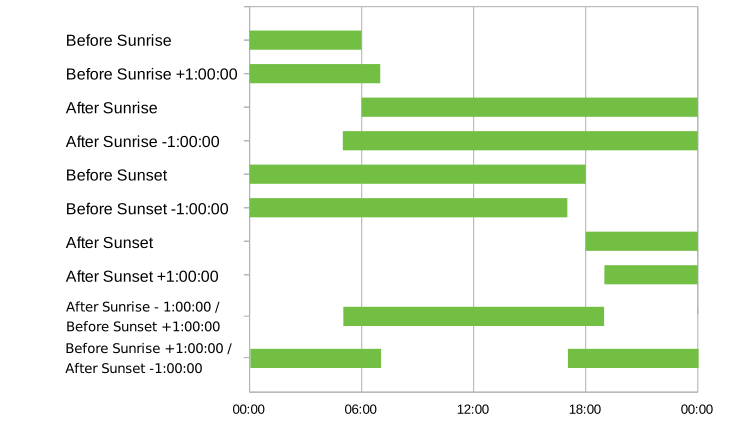
Note that if only before key is used, the condition will be true from midnight until sunrise/sunset. If only after key is used, the condition will be true from sunset/sunrise until midnight. If both before: sunrise and after: sunset keys are used, the condition will be true from midnight until sunrise and from sunset until midnight. If both after: sunrise and before: sunset keys are used, the condition will be true from sunrise until sunset.
The sunset/sunrise conditions do not work in locations inside the polar circles, and also not in locations with a highly skewed local time zone. In those cases it is advised to use conditions evaluating the solar elevation instead of the before/after sunset/sunrise conditions.
This is an example of 1 hour offset before sunset:
conditions:
  - condition: sun
    after: sunset
    after_offset: "-01:00:00"
This is ‘when dark’ - equivalent to a state condition on sun.sun of below_horizon:
conditions:
  - condition: sun
    after: sunset
    before: sunrise
This is ‘when light’ - equivalent to a state condition on sun.sun of above_horizon:
conditions:
  - condition: sun
    after: sunrise
    before: sunset
A visual timeline is provided below, showing an example of when these conditions are true. In this chart, sunrise is at 6:00, and sunset is at 18:00 (6:00 PM). The green areas of the chart indicate when the specified conditions are true.
Switch conditions
The available conditions are:
- Switch is on (
switch.is_on). - Switch is off (
switch.is_off).
For information about each condition, refer to the Switch conditions.
Temperature condition
The available condition is: Temperature value (temperature.is_value).
For details, refer to the Temperature value condition page.
Template condition
The template condition tests if the given template renders a value equal to true. This is achieved by having the template result in a true boolean expression or by having the template render True.
conditions:
  - alias: "Iphone battery above 50%"
    condition: template
    value_template: "{{ (state_attr('device_tracker.iphone', 'battery_level')|int) > 50 }}"
Within an automation, template conditions also have access to the trigger variable as described here.
Be careful when combining and/or with a value that isn’t already a boolean, such as a list, string, or number. In Python and Jinja, and/or don’t always evaluate to a boolean. Instead, they return whichever operand determined the result. For example, if some_list is a non-empty list like [255, 0, 0]:
{{ some_list is defined and some_list }}[255, 0, 0]This renders as the list itself, not true. Since a template condition only passes when the rendered result is the (case-insensitive) string true, the condition silently fails even though some_list is genuinely defined and non-empty. Force a real boolean with a comparison instead:
conditions: "{{ some_list is defined and some_list | length > 0 }}"
Template condition shorthand notation
The template condition has a shorthand notation that can be used to make your scripts and automations shorter.
For example:
conditions: "{{ (state_attr('device_tracker.iphone', 'battery_level')|int) > 50 }}"
Or in a list of conditions, allowing to use existing conditions as described in this chapter and one or more shorthand template conditions
conditions:
  - "{{ (state_attr('device_tracker.iphone', 'battery_level')|int) > 50 }}"
  - condition: state
    entity_id: alarm_control_panel.home
    state: armed_away
  - "{{ is_state('device_tracker.iphone', 'away') }}"
This shorthand notation can be used everywhere in Home Assistant where
conditions are accepted. For example, in and, or
and not conditions:
conditions:
  - condition: or
    conditions:
      - "{{ is_state('device_tracker.iphone', 'away') }}"
      - condition: numeric_state
        entity_id: "sensor.temperature"
        below: 20
It’s also supported in the repeat action’s while or until option, or in a choose action’s conditions option:
- while: "{{ is_state('sensor.mode', 'Home') and repeat.index < 10 }}"
  sequence:
    - ...
- choose:
    - conditions: "{{ is_state('sensor.mode', 'Home') and repeat.index < 10 }}"
      sequence:
       - ...
It’s also supported in script or automation condition actions:
- condition: "{{ is_state('device_tracker.iphone', 'away') }}"
Text condition
The available condition is: (text.is_equal_to).
For details, refer to the Text is equal to condition page.
Time condition
The time condition can test if it is after a specified time, before a specified time or if it is a certain day of the week.
conditions:
  - alias: "Time 15~02"
    condition: time
    # At least one of the following is required.
    after: "15:00:00"
    before: "02:00:00"
    weekday:
      - mon
      - wed
      - fri
Valid values for weekday are mon, tue, wed, thu, fri, sat, sun.
Note that if only before key is used, the condition will be true from midnight until the specified time.
If only after key is used, the condition will be true from the specified time until midnight.
Time condition windows can span across the midnight threshold if both after and before keys are used. In the example above, the condition window is from 3pm to 2am.
The after times are inclusive while before are exclusive. In the example above, if the time was at 3pm (15:00:00) then it meets the after time condition. If the time was at 2am (2:00:00), it would fail the condition because it will only be valid up to 1:59:59.
A better weekday condition could be by using the Workday Binary Sensor.
For the after and before options a time helper (input_datetime entity), a time entity, or another sensor entity containing a timestamp with the “timestamp” device class, can be used instead.
conditions:
  - alias: "Example referencing a time helper"
    condition: time
    after: input_datetime.house_silent_hours_start
    before: input_datetime.house_silent_hours_end

  - alias: "Example referencing a time entity"
    before: time.dnd_start

  - alias: "Example referencing another sensor"
    after: sensor.groceries_delivery_time
Note that the time condition only takes the time into account. If a referenced sensor or helper entity contains a timestamp with a date, the date part is fully ignored.
Timer conditions
For the full list of available conditions and its details, refer to the Timer conditions.
To-do list conditions
For the full list of available conditions and its details, refer to the To-do list conditions.
Triggered by condition
The triggered by condition can test if an automation was triggered by a certain trigger, identified by the trigger’s id.
conditions:
  - condition: trigger
    id: event_trigger
For a trigger identified by its index, both a string and integer is allowed:
conditions:
  - condition: trigger
    id: "0"
conditions:
  - condition: trigger
    id: 0
It is possible to give a list of triggers:
conditions:
  - condition: trigger
    id:
      - event_1_trigger
      - event_2_trigger
Update conditions
For the full list of available conditions and its details, refer to the Update conditions.
Vacuum conditions
The available Vacuum conditions are:
- Vacuum is cleaning (
vacuum.is_cleaning). - Vacuum is docked (
vacuum.is_docked). - Vacuum is paused (
vacuum.is_paused). - Vacuum is returning (
vacuum.is_returning). - Vacuum is encountering an error (
vacuum.is_encountering_an_error).
For information about adding vacuum conditions in an automation and examples, refer to Vacuum conditions.
Valve conditions
For the full list of available conditions and its details, refer to the Valve conditions.
Water heater conditions
For the full list of available conditions and its details, refer to the Water heater conditions.
Zone conditions
Zone conditions test if an entity is in a certain zone. The entity can be either a person or a device tracker.
For the full list of available conditions and its details, refer to the Zone conditions.
YAML examples
conditions:
  - alias: "Paulus at home"
    condition: zone.in_zone
    target:
      entity_id: device_tracker.paulus
    options:
      zone: zone.home
It is also possible to test the condition against multiple entities at once. The condition will pass if all entities are in the specified zone.
conditions:
  - condition: zone.in_zone
    target:
      entity_id:
        - device_tracker.frenck
        - device_tracker.daphne
    options:
      zone: zone.home
To test if an entity is matching a set of possible zones, you need to add two zone conditions in an Or condition block.
condition: or
conditions:
  - condition: zone.in_zone
    target:
      entity_id: device_tracker.paulus
    options:
      zone: zone.home
  - condition: zone.in_zone
    target:
      entity_id: device_tracker.paulus
    options:
      zone: zone.work
Or, combine multiple entities with multiple zones. In the following example, both entities need to be either in the home or the work zone for the condition to pass.
conditions:
  - condition: or
    conditions:
      - condition: zone.in_zone
        target:
          entity_id:
            - device_tracker.frenck
            - device_tracker.daphne
        options:
          zone: zone.home
      - condition: zone.in_zone
        target:
          entity_id:
            - device_tracker.frenck
            - device_tracker.daphne
        options:
          zone: zone.work

## Examples

```yaml
conditions:
  - condition: numeric_state
    entity_id: sun.sun
    value_template: "{{ state.attributes.elevation }}"
    below: 1
  - condition: state
    entity_id: light.living_room
    state: "off"
  - condition: time
    before: "23:00:00"
    after: "14:00:00"
  - condition: state
    entity_id: script.light_turned_off_5min
    state: "off"
Disabling a condition
Every individual condition can be disabled, without removing it.
To do so, add enabled: false to the condition configuration.
This can be useful if you want to temporarily disable a condition, for example, for testing. A disabled condition will behave as if it were removed.
For example:
# This condition will always pass, as it is disabled.
conditions:
  - enabled: false
    condition: state
    entity_id: sun.sun
    state: "above_horizon"
Conditions can also be disabled based on limited templates or blueprint inputs.
blueprint:
  input:
    input_boolean:
      name: Boolean
      selector:
        boolean:
    input_number:
      name: Number
      selector:
        number:
          min: 0
          max: 100

  trigger_variables:
    _enable_number: !input input_number

  conditions:
    - condition: state
      entity_id: sun.sun
      state: "above_horizon"
      enabled: !input input_boolean
    - condition: state
      entity_id: sun.sun
      state: "below_horizon"
      enabled: "{{ _enable_number < 50 }}"